The ‘Wondrous Forests of the Walpole Wilderness’ have captured the hearts of Australians, earning the title of 2025’s Eucalypt of the Year.
Among these ancient giants stand the awe-inspiring Tingles, towering relics of a bygone era. Yet, despite these accolades, the Department of Biodiversity, Conservation and Attractions (DBCA) still has the Nornalup block in the heart of this region on its prescribed burn list—a decision that could have catastrophic consequences.
The destruction of irreplaceable giants
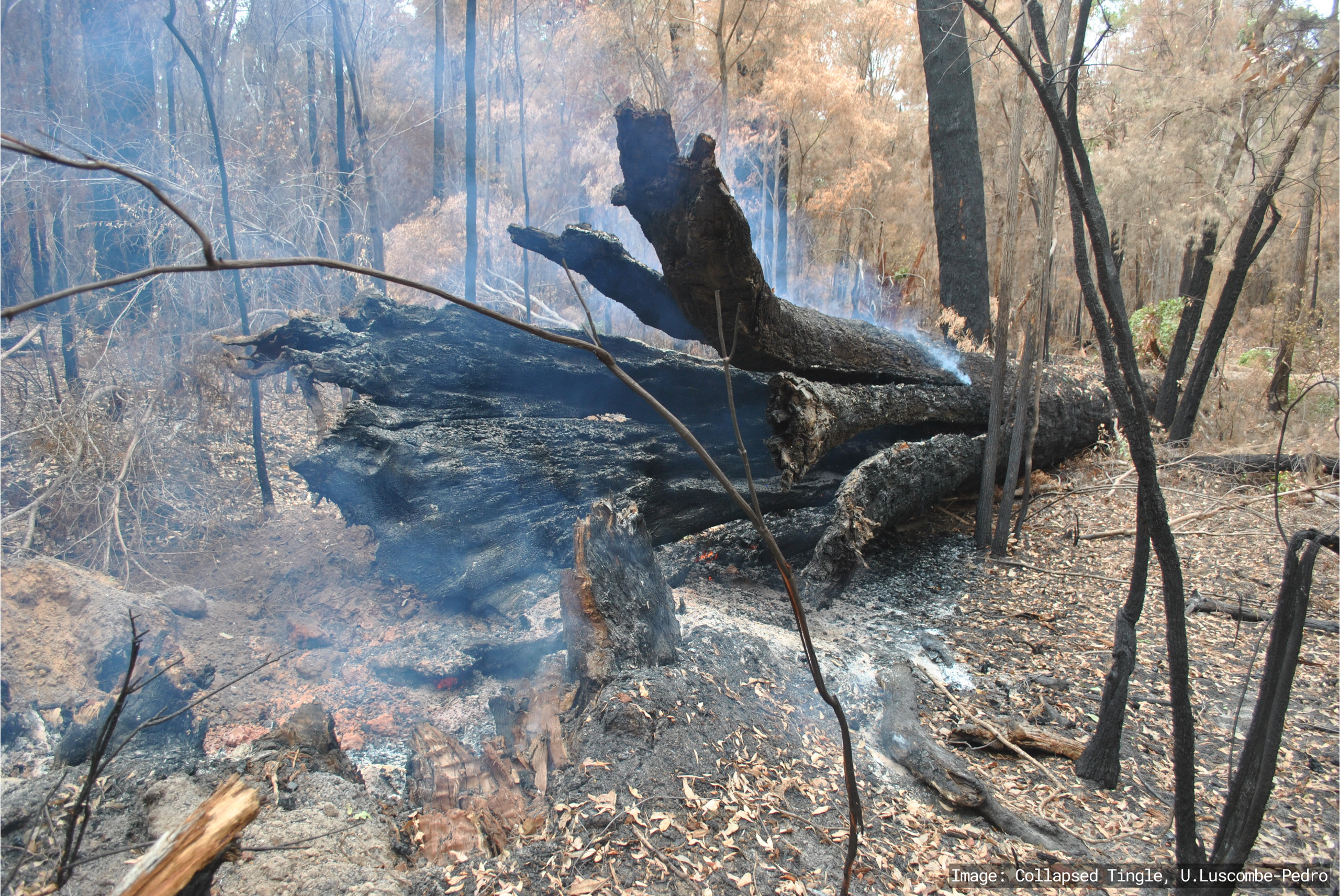
DBCA reported in January that only one giant tree collapsed due to their December 2024 prescribed burn near the famed Valley of the Giants Tree Top Walk. However, citizen scientists have uncovered the heartbreaking truth: over 180 ancient Tingles and Karri trees have fallen. Even more alarming, another giant Tingle tree recently succumbed, months later to the damage inflicted by the fire.
Why Tingles should never be burned
Tingles are unique among eucalypts. They are not fire-adapted in the same way as other species. Their massive, hollowed-out bases may survive for centuries, but intense and frequent fire can fatally weaken them. Prescribed burns increase their susceptibility to collapse, jeopardizing not only the trees themselves but also the delicate ecosystem they support. From the endangered Sunset Frog to the tiny Pygmy Tingle Trapdoor Spider, many species rely on the unburnt hollows and moist understorey of these ancient forests.
As Fire & Biodiversity WA Founder and/or Convenor of the Denmark Environment Centre Bart Lebbing highlights, “Tingle only grows in 60 square kilometers—and that is on the whole planet.” Yet these irreplaceable trees are being sacrificed under outdated fire management practices. Their unique structure means that fire can burn within their trunks for days, fatally compromising their integrity.
A call for smarter fire management
Prescribed burning is often justified as a bushfire mitigation tool, yet evidence suggests that alternative approaches are more effective in high-rainfall environments like the Walpole Wilderness. Instead of burning these irreplaceable forests, the WA government must invest in cutting-edge bushfire detection and suppression technologies. Early fire detection systems, drones, and improved rapid response teams offer better, safer solutions for both people and ecosystems.
We are hosting free webinar on April 16 where you can hear from experts leading the field in rapid detection and suppression technology.

Take action: Protect the Tingles
The battle to save the Tingles is far from over. We must make our voices heard before DBCA proceeds with the next inappropriate and destructive burn near Nornalup. Send an email to the WA government today, demanding that Nornalup be removed from the prescribed burn list and that investment be redirected towards modern early detection and bushfire suppression strategies.
These trees have stood for centuries—let’s ensure they stand for centuries more. The time to act is now.