
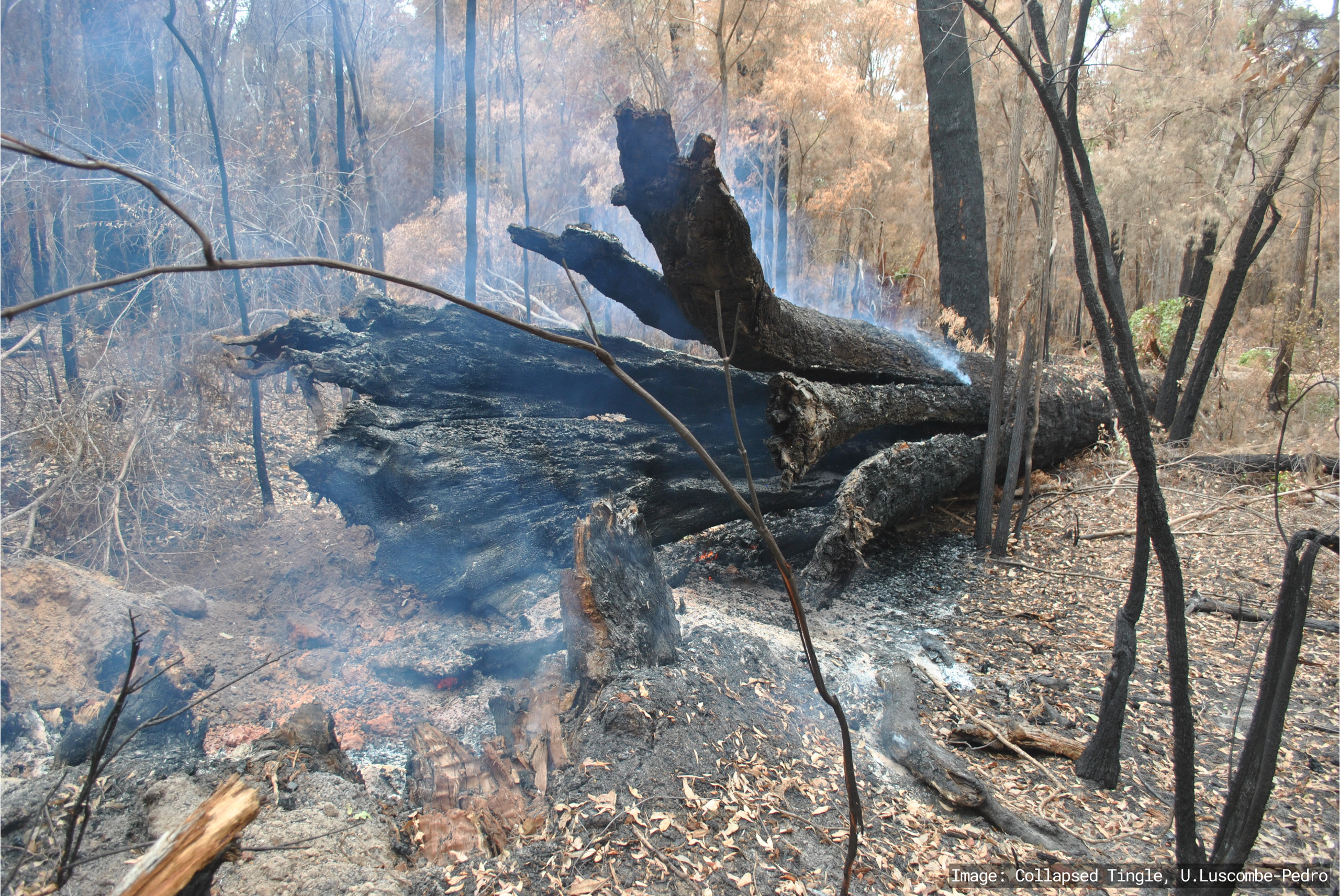
Over 150 giant Tingle and Karri trees have collapsed after a prescribed burn next door to the famed Valley of the Giants Treetop Walk. The ‘Giants East’ forest block was ignited in late December by the Department of Biodiversity, Conservation and Attractions (DBCA).
A statement released a month later reported that just one giant Tingle tree had collapsed and 300 other Tingle and Karri trees on the burn perimeter had been protected and described the burn as a success. Local researchers are disputing these claims, having spent the last month documenting recently fallen trees over 90cm in diameter.

Photo: D. Jennings
Local resident and ANU environmental science student, Uralla Luscombe-Pedro said
“I surveyed the area for fire-felled trees after the Giants prescribed burn and estimated 180 mature red tingle, yellow tingle, karri and marri trees were felled by the burn in an area less than 100 hectares.”
“Large fallen trees, branches and entire tree canopies that were burned off their trunks are scattered across the forest floor, and in some places, trees have collapsed in groups. From any standpoint in the forest, it’s clear this was a severe and damaging fire.”
Features of the Tingle tree; its shallow roots, fibrous bark, burls and gnarls, make them susceptible to frequent and severe fire. Each burn sets up more trees to fall in the next fire event because of the cumulative damage that burning does to their structure and stability. Recent studies show that Tingle forests have naturally low flammability when they are left unburnt for long periods.
he Walpole-Nornalup National Park Association (WNNPA)’s Dr David Edmonds commented
“The WNNPA was incredibly shocked and disappointed on seeing the outcomes from the recent prescribed burn in Giants East block. The WNNPA first raised concerns about the burning of the Tingle forest over 30 years ago. In 1997 a trial burn was conducted in the very same forest leading to the collapse of at least 30 trees. This was viewed by both the WNNPA and the government department of the time as an unacceptable result and recommendations were made to avoid this level of collapse in the future.
The WNNPA are calling for a halt to another burn planned in nearby Tingle forest later this season and they support a call for an increase in pre- and post-fire monitoring programs, robust and meaningful ecological outcomes to be built into burn prescriptions and an independent review into prescribed burning.
WA Forest Alliance (WAFA) Senior Campaigner Jason Fowler, said
“Western Australians overwhelmingly support the protection of SW Forests. The government has recognised that in the ban on native forest logging, now they need to take the next step and overhaul the prescribed burning program to prevent this unnecessary destruction. Urgent changes are required to ensure fire-sensitive species and communities like tingles are not burnt in this manner”.
Scientists, Conservation groups and South coast residents are seeking answers from the government on the failures of this burn and how they will ensure this does not happen again.
6.7MB PDF
Protect the Tingles from prescribed burning
It is of the highest priority that the Tingles are protected from fire, before it is too late.
Please contact the Premier, relevant Ministers and DBCA using our template to urge them to remove Tingle forests from the burn plan. Enter your details to start writing your email.